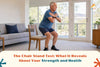
Maintaining good balance plays an important role in staying mobile, confident and independent as we age. Standing balance exercises can help older adults practise the skills needed to control their body position, respond to changes in movement and feel steadier during everyday activities.
Balance is essential for everyday movements like stepping, turning, reaching and changing direction. Regular practice can help support steadier, more confident movement in daily life. Regularly challenging these skills can therefore have practical benefits that extend into daily life.
 Falls are also an important health concern for older Australians. The Australian Commission on Safety and Quality in Health Care identifies falls as one of the biggest causes of injury among older people in Australia and notes that they can have lasting effects on health and independence.
Why Standing Balance Exercises Matter as We Age
Balance relies on your vision, inner ear, muscles, joints and brain working together to keep you steady. As strength, mobility, coordination and reaction time can change with age, balance training for seniors involves much more than simply standing on one leg.
Effective balance activities can challenge the ability to:
-
control body position
-
coordinate the feet and legs
-
respond to changes in direction
-
recover from small losses of balance
The World Health Organization specifically recommends that adults aged 65 and over include activities that emphasise balance and coordination, alongside muscle-strengthening activities, to support health and help prevent falls.
5 Standing Balance Exercises for Seniors
Before beginning, choose a clear, uncluttered area and have a sturdy bench, chair or countertop nearby for support if required. Start with the version that feels manageable rather than immediately trying to make an exercise harder.
1. Side-to-Side Weight Shifts
Weight shifting helps practise the transfer of body weight needed for stepping and changing direction.
How to do it: Stand with your feet hip-width apart. Slowly shift your weight to one side, return to the centre, then shift to the other side. Keep both feet on the floor.
Why practise it?
This simple balance exercise for older adults develops awareness of how body weight moves over the feet. It can also prepare the body for more challenging activities involving stepping and changes of direction.
2. Heel-to-Toe Standing
Standing with one foot directly or partially in front of the other creates a narrower base of support. That gives your balance system a different challenge compared with standing with the feet apart.
How to do it: Place one foot slightly in front of the other, progressing towards heel-to-toe if comfortable. Hold briefly, then switch feet. Keep a sturdy support nearby.
If heel-to-toe feels too difficult, leave a small space between the feet or place them slightly wider apart.
Why practise it?
A narrower stance requires the body to make smaller, more precise postural adjustments. Practising these adjustments can help challenge postural control, coordination and stability.
3. Standing Marches
Balance becomes more demanding once a foot leaves the floor. Standing marches introduce this challenge while also working the hip and leg muscles involved in walking.
How to do it: Stand tall and slowly lift one foot, lower it with control, then repeat with the other side. Rather than trying to lift the knees as high as possible, focus on staying upright and controlling each movement.
Why practise it?
For a brief moment during each march, most of your weight is supported by one leg. This challenges single-leg stability, weight transfer and coordination — all skills that are regularly used when walking.
Strength also contributes to how well we move and maintain our physical capacity. For more on why loading the body matters with age, read our previous article, Weight-Bearing Exercise: Why Your Bones Need It After 60.
4. Side Steps
Everyday movement does not happen only forwards and backwards. We frequently need to move sideways when navigating furniture, moving around the kitchen or making space for another person.
How to do it: Step one foot to the side, bring the other foot towards it and continue for several controlled steps before changing direction. Keep your toes pointing forward as much as comfortable and avoid rushing the movement.
Why practise it?
Side stepping challenges lateral balance, coordination and the muscles around the hips. It also introduces a different direction of movement, helping balance training more closely reflect the varied ways we move throughout the day.
5. Controlled Step and Return
This exercise adds movement in different directions while asking the body to regain a stable starting position after every step.
How to do it: Step forward and return, step to the side and return, then take a small step backwards if comfortable. Repeat with the other foot. Keep the steps small initially. A sturdy support should remain within easy reach if needed.
Why practise it?
Each time you step away from your starting position, your centre of mass changes. Returning with control requires coordination between your legs, trunk and balance systems.
How Can Standing Balance Exercises Help With Fall Prevention?
There is no single exercise that can guarantee someone will not fall. Falls can be influenced by many factors, including muscle weakness, medications, vision, footwear, environmental hazards, health conditions and previous falls.
However, exercise is an important part of a broader fall prevention approach.
The updated 2025 guidance from the Australian Commission on Safety and Quality in Health Care recommends ongoing exercise for older people, with programs primarily targeting balance, mobility and strength. Its community-care guidance recommends approximately two to three hours of exercise per week on an ongoing basis.
This is an important distinction: improving balance is generally not about doing one exercise occasionally. It comes from regularly giving the body appropriate opportunities to practise strength, coordination and balance skills.
Balance Training From Home
At Summit Health Solutions, our Telehealth Exercise Program is designed for seniors who want to keep moving from home. Participants join live group exercise sessions online, making it possible to exercise alongside others without needing to travel to a physical class.
Sessions include structured movement that supports areas such as strength, balance and mobility, helping older adults continue building movement into their regular routine.
FAQs:
1. How often should seniors do standing balance exercises?
Regular practice is generally more beneficial than occasional sessions. How often will depend on your mobility, health and current activity level, and balance exercises can form part of a broader exercise routine.
2. What is the best standing balance exercise for seniors?
There is no single best exercise. The right activity should challenge your balance while still allowing you to move safely and with control.
3. Can balance exercises prevent all falls?
No. Balance exercises can support strength, stability and mobility, but falls can also be influenced by medications, vision, footwear, health conditions and environmental hazards.
4. What should I hold onto during standing balance exercises?
Use a stable support such as a sturdy chair or fixed countertop if needed. Avoid objects that could slide, roll or tip over.
5. What if I feel unsteady during balance exercises?
Stop and regain a stable position. You can make the exercise easier by reducing the movement or using support. New or persistent balance problems should be discussed with a healthcare professional.